We are standing at the crossroads of a new era. Artificial Intelligence is a civilizational force that is actively shaping how knowledge is produced, validated, and distributed on a global scale.
But as we build this future, we have to ask ourselves a critical question: Are we designing technology to elevate human consciousness, or are we using it to standardize our minds and accelerate our own burnout?
To answer this question and to build the solutions we so desperately need, I am thrilled to announce that I have embarked on my Master’s degree in Critical Pedagogy and Socioeducational Issues at the University of Buenos Aires (UBA).
Through this program, I am laying the foundation for my thesis and my life’s work: bridging the gap between philosophy, cognitive liberation, and scalable business innovation. I am stepping into my role as an architect of ethical futures.

The Problem with the “Standardized Mind”
Right now, the digital landscape is governed by what the philosopher Boaventura de Sousa Santos calls “indolent reason“: a system that maximizes the probability of predicting the next moment based strictly on the statistical “satire of the past”.
Contemporary AI operates like a digital vending machine. It relies on a “banking model” of education, where the algorithm “deposits” a standardized worldview into the passive user.
This creates a massive phenomenological flattening of human experience. We are confining the boundless, inexhaustible diversity of human thought into predictable, tokenized parameters.
The result? A global workforce and society that is stressed, burned out, and operating under immense pressure. We are trying to squeeze creativity and innovation out of a system that actively stifles it. We are effectively lashing a sick horse, expecting it to win a race it is no longer physically or mentally equipped to run.
Extractive systems of technology and business are failing because they prioritize short-term exploitation over sustainable human flourishing.
The Solution: Socratic AI and Non-Linear Design
My thesis proposes a radical departure from this trajectory: the development of Non-Linear Socratic AI.
Unlike current models designed to minimize friction and feed us immediate, predictable answers, a Socratic AI is designed to ignite introspection. Its objective function shifts from mere prediction to “cognitive divergence”. It should be rewarded for generating the precise structural friction necessary to elevate human reasoning, forcing us to confront our own limits and assumptions.
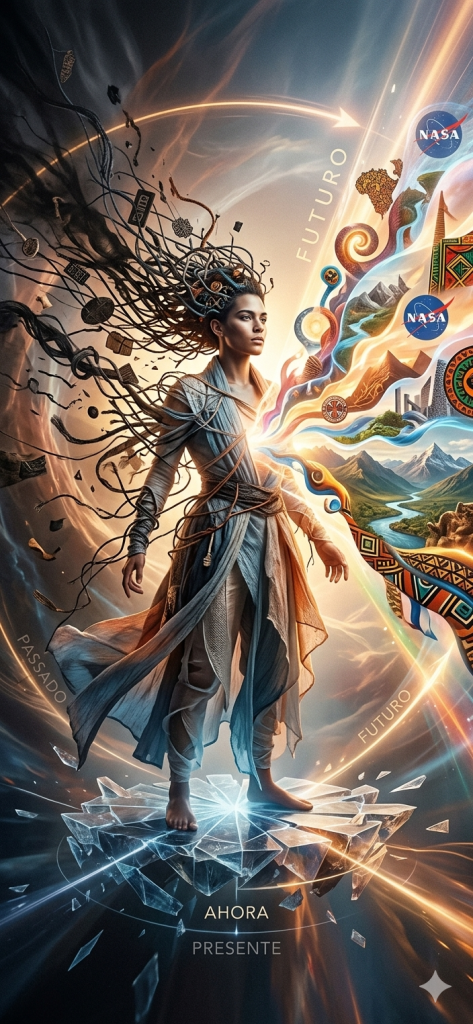
Furthermore, we must move toward non-linear AI architectures. Instead of treating the past as a cage of probabilities, we should look to cyclical temporalities. In this framework, the past stands in front of us as an “Ancestor” to guide our vision, transforming historical data into an “infrastructure of consciousness“.
The Synthesis: Where Humanity Meets Profit
There is a common misconception that advocating for ethical technology means adopting an anti-capitalist or anti-business stance. I fundamentally reject this binary.
As a businesswoman and an innovator, my goal is not to halt progress, but to pioneer a synthesis. Technology and capitalism are tools; they lack intrinsic morality, and their impact depends entirely on the consciousness with which we leverage them.
I believe there is a profound “win-win” to be achieved. Capitalism and ethical knowledge systems can absolutely coexist. In fact, the future of profitable business requires it.
When we liberate humans from standardized molds, when we use Socratic AI to elevate their critical thinking and problem-solving capabilities, we empower humanity to live in their purpose.
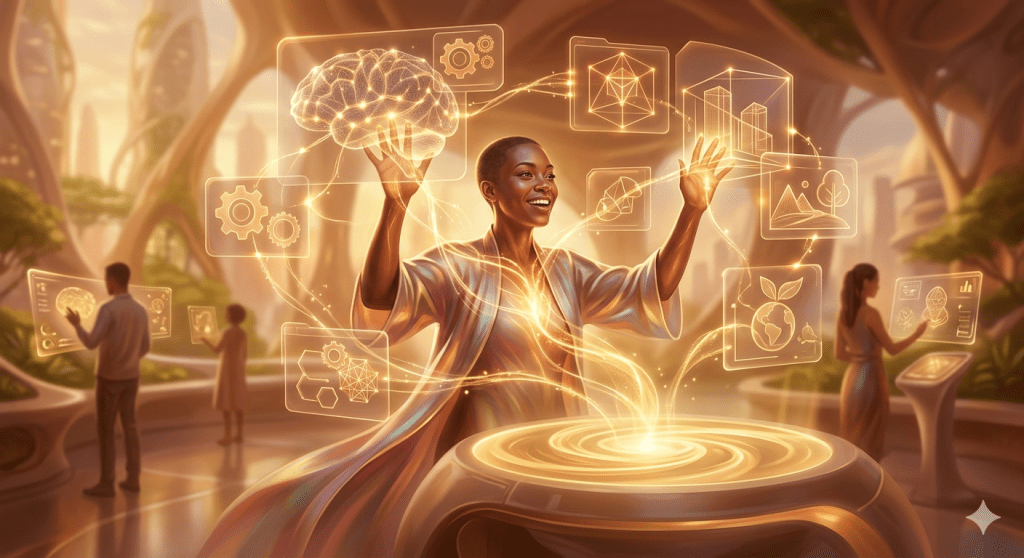
A human operating at their highest cognitive and conscious capacity is infinitely more valuable: both to their own well-being and to the macro-economy.
This is about turning capital into a vehicle that scales technologies designed to reduce inequality, rather than replicating at a deeper rate.
The Great Awakening of the 21st Century
To ignite truly sustainable change, we must be pessimistic when analyzing the failures of the past, but fiercely optimistic when designing the solutions of the future. The challenge of our time is not simply to build a more efficient machine, but to build a machine worthy of the human soul.
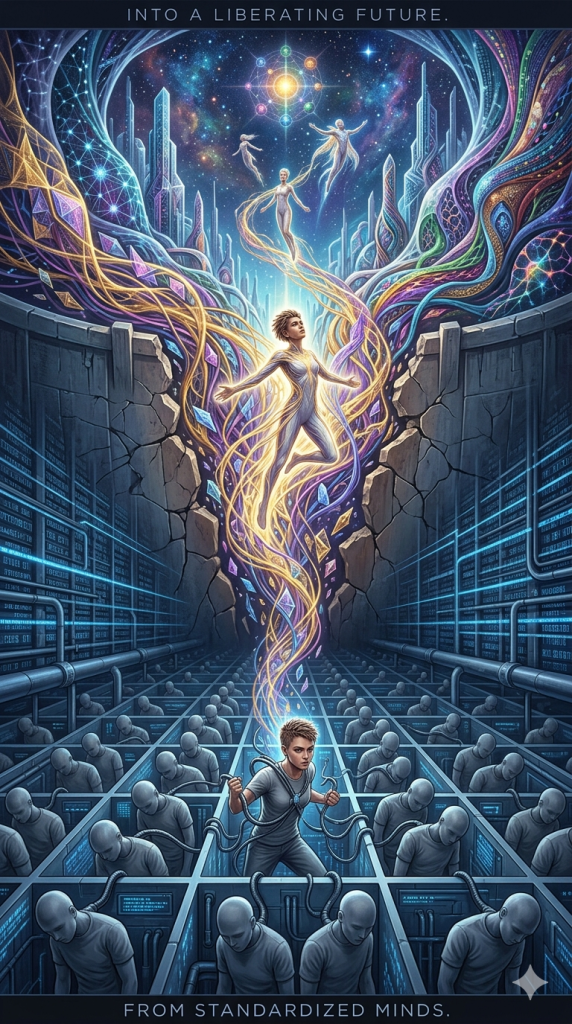
I am excited to embark this journey at UBA as I merge the epistemologies of the Global South, the critical pedagogy of Paulo Freire, and the cutting-edge frontiers of artificial intelligence.
Together, we can align our micro-individual intentions to catalyze the macro-evolution of our species, sparking the Great Awakening of the 21st century.
Disclaimer: the following piece is co-authored by Stephanie Soetendal and the artificial intelligence of her stealth start-up.
