There are certain people we meet only once and remember forever.
And then there are the people we meet several times, briefly, almost accidentally, whose presence seems to disappear into the background of our lives—until later, we realize they left something behind.
I met him on a stage in Buenos Aires.
He was the kind of person who didn’t need an introduction.
His name usually arrived before he did.
And yet, when I met him, I did not know who he was. I was in a foreign land by the Southern tip of the globe.
We were both speakers at this international forum, surrounded by the familiar choreography of public life: bright stage lights, microphones, name badges, polished shoes, reporters, and people moving quickly between rooms.
I had just finished giving a keynote on ethics.
I spoke about artificial intelligence, but not really about artificial intelligence.
I spoke about wisdom. About the strange possibility that, in a world where machines may soon know more than we do, our greatest human advantage might be our ability to understand what separates humans from machines, and our larger role in being the creators of it.
I called our wisdom, ethics, and values our source code of creation.
Then he took the stage.
I always laugh when I remember how he got on stage, and plotted himself into one of the Q and A chairs.
He sat down like he was an uncle giving a living room talk to his nieces and nephews. I never told him this, but I catch myself laughing every now and then upon the memory of that day.
He was already accustomed to rooms like this. Accustomed to microphones, questions, cameras, the weight of a name that preceded him.
Then, he spoke about loneliness.
About leaving Argentina for Cambridge. About arriving somewhere foreign and finding himself alone. About the physiological and psychological consequences of isolation.
At one point, he compared loneliness to the impact of smoking.
I listened carefully.
Something in me resisted the simplicity of the idea.
When the Q&A began, I raised my hand.
The microphone arrived.
I told him that I understood what he meant, but that my experience had been almost the mirror image of his.
I had gone from Boston to Latin America alone.
And then I asked:
“What if we are supposed to learn how to be happy alone?
What if the goal isn’t to become dependent upon other people to feel complete?
What if we become whole by ourselves, and relationships become something beautiful that we add, rather than something we require?”
He stopped.
There was a small silence.
Then he asked me to repeat the question.
I smiled.
I knew exactly what he was doing.
He was buying himself time to think.
I called him out on it.
I do not remember his answer.
But I remember the pause.
And I remember what happened afterward.
He asked the moderator who I was.
We were introduced as he got off stage.
He signaled to the head of speakers to pass his phone number.
I came to find out that he was a politician.
Some time later, I found myself sitting across from him in his office.
It was an elegant room, the kind of room that seemed designed for important conversations. Books. Papers. Prestigious degrees framed on the wall. The polished posh of a life lived between science, public affairs, and the enormous expectations that come with both.
We drank coffee.
The first conversation was interesting.
The second was different.
By then, I had stopped being the woman he had seen on a stage.
And he had stopped being the man everyone else saw on his.
He was in the middle of a political campaign.
I was in the middle of a sabbatical.
He was surrounded by public life.
I was trying to escape mine.
I told him things I hadn’t planned to tell him.
The polished biography began to dissolve.
The tech founder disappeared.
The keynote speaker disappeared.
The woman from Boston disappeared.
There was simply a person sitting across from another person.
He listened.
And then he said something I have never forgotten:
“Ahora eso es más interesante que ser la tech CEO de Boston.”
For a moment, the room became very quiet.
Because I understood exactly what he meant.
The title wasn’t the interesting part.
The person underneath it was.
We talked about visibility.
About pressure.
About the peculiar exhaustion of being seen, recognized, and admired.
I told him that after spending years around powerful people, global institutions, the press, and rooms where decisions seemed to happen behind closed doors, I had begun to see public life differently.
Then I gave him a metaphor.
An ant farm.
A rectangular glass box.
Red ants on one side.
Black ants on the other.
I told him to imagine someone externally shaking the entire box.
The ants feel the sudden disruption
What do they do?
They look across the other side.
They assume the other ants caused it.
So they attack one another.
I looked at him.
“Who shook the box?”
The ants never look up.
They look sideways.
That was the point.
He was already considering stepping away from politics.
A week later, I saw on the news that he did.
I have never believed that one conversation can explain another person’s life.
People carry decisions for months and years before anyone else sees them.
But sometimes a stranger doesn’t plant an idea in your mind.
Sometimes they simply give shape to one that was already there.
After that, our lives continued to intersect in strange ways.
There were ideas.
Possibilities.
Introductions.
Conversations about working together.
Some doors opened.
Others never did.
There was always another meeting that might happen.
Another coffee.
Another idea.
And yet, somehow, the connection remained.
Just quietly.
A message here.
A conversation there.
A question.
A congratulations.
A moment of encouragement.
Two people moving through entirely different worlds, occasionally finding themselves standing in the same doorway.
Over time, I began to understand something about that relationship.
We had both entered public life because we believed, in our own ways, that our work could contribute to something larger than ourselves.
But public life has a strange appetite.
A set of rules to the game.
It takes your name.
Your photograph.
Your accomplishments.
Your résumé.
Your reputation.
And eventually, if you aren’t careful, it can begin to consume the person underneath them.
Perhaps that’s why that second coffee stayed with me.
Because for a few hours, neither of us needed to be impressive.
We could simply be human.
And I learned something from that.
Vulnerability is not a weakness; it is an eager part we all crave as humans: to be seen genuinely for who we are internally and not who we appear to be externally. A dissonance between our inner worlds and our outer realities.
Not because accomplishments don’t matter.
But because they are not the whole person.
I didn’t meet him as the famous man whose name filled newspapers.
I met him as a curious, complex human being sitting across a table.
And he, in turn, saw something beneath my own titles.
That sentence— that is more interesting than being the tech CEO from Boston —became a seed.
I didn’t know what it would grow into.
Time passed, and that seed became a part of my next venture.
When I began building Sapii, I became increasingly interested in the space beneath the accomplishments.
In the creation of a person.
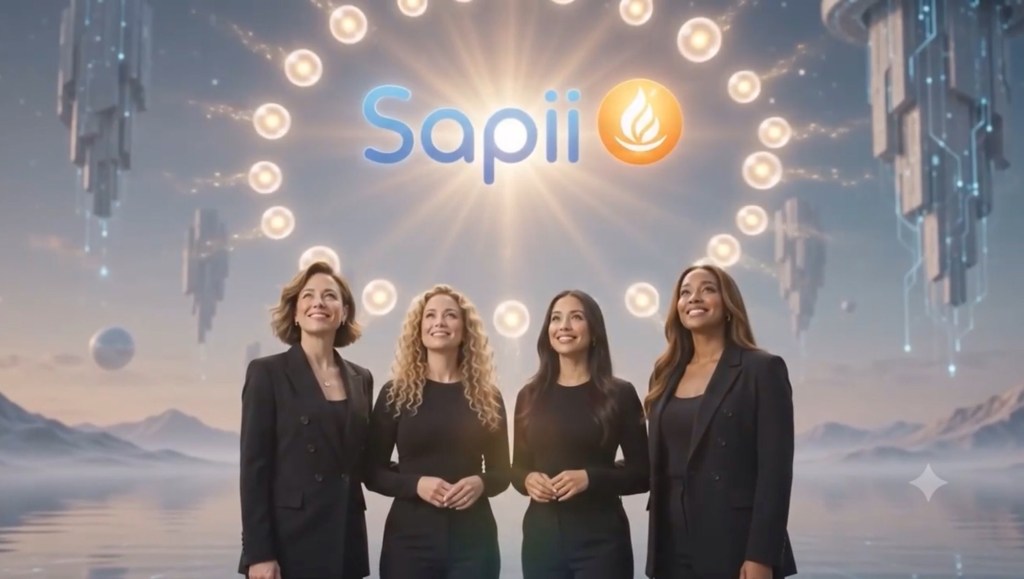
from left to right: Stephanie Soetendal, Nicole de Souza, Bianca Conduta Elias, and Kareema Bryant
In the person beneath the armor.
In the development of character.
In the construction of cognitive perspective.
In the dissonance between our inner feelings and our external world.
The part of a person that doesn’t fit neatly into a profile.
The questions nobody puts on an application.
The fears hidden behind achievement.
The uncertainty.
The private voice beneath the public one.
And eventually, I realized that if I wanted to build something capable of meeting people there, I had to be willing to go there myself.
I had to become vulnerable.
Not strategically vulnerable.
Not the curated vulnerability of social media.
Real, raw vulnerability.
Perhaps that is one of the strangest gifts another person can give us:
The permission to see ourselves differently.
The inspiration to allow ourselves to simply be human.
I never learned exactly what that conversation meant to him.
Maybe the ant farm was simply an interesting metaphor.
Maybe the timing was coincidence.
Maybe the coffee was simply two people talking.
Maybe some things mattered more to me than they did to him.
We don’t always get to know.
And perhaps that’s the point.
At times, a person simply appears at a particular crossroads.
They see you without the costume.
And then life moves forward.
I still think about the glass box.
The red ants.
The black ants.
The invisible hand shaking everything beneath their feet.
And the question I asked that afternoon:
Who shook the box?
Perhaps wisdom begins there.
Not when we see opposite ends of the spectrum as our enemy.
Not when we become better at defending our side.
But when we finally stop looking across the glass—
and look up to what we’ve been too busy to see.
That beneath the titles, the recognition, and the applause
Resides humanity: raw, vulnerable, and ready to be seen.
Disclaimer: the following blog post was co-authored and edited with ChatGPT.
